
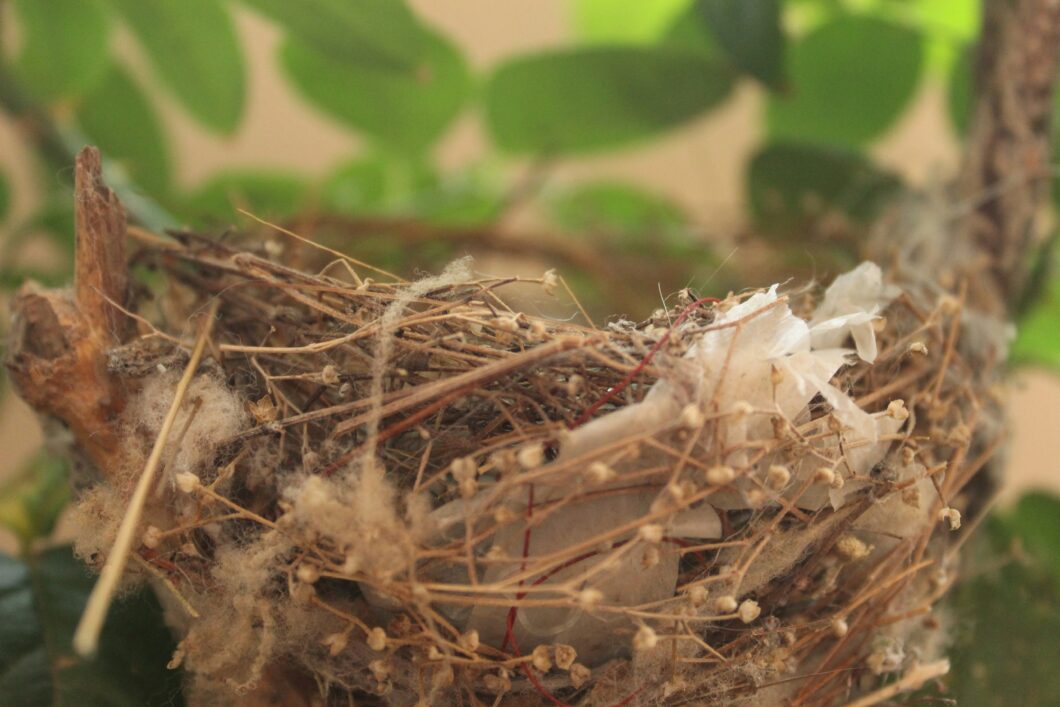
The bird came for my wife’s hair the day she asked for a divorce. We were arguing about time. I still had two more days of our trial separation before we’d talk through the results of said separation. She said she’d given me enough years of her life. And then the bird swooped down and snatched a strand of her hair. Hand on her head, she ran for cover.
I didn’t want a divorce. I wanted her to change her mind.
The bird was a black-crested titmouse, small and gray with a black mohawk, a songbird but cranky when it wanted to be, its complaint like wrenching metal. It disappeared into the oak canopy, one hair richer.
This happened on a Sunday.
My wife took a bottle of red wine out into the yard that night. “It’s the weekend,” she said.
From the porch our son said, “It’s always the weekend for you.”
He was fourteen and blamed the alcohol, and I thought, that’s not the entire story, but it’s fair. My wife fell asleep in the lawn chair at dusk, and I was angry enough to leave her there. The bird went to work.
By morning she was bald but no less righteous. She dug out an old ball cap I used to wear to work. It had the name of her brother’s power wash company hundreds of miles away. It reminded her she was alone here.
“You have me,” I said.
“Debatable,” she said.
“But you’re still my wife.”
“Barely.” She lifted the hat to rub her new baldness.
I vowed to retrieve this bird’s nest of her hair. To myself. I vowed to myself. She didn’t want to hear another vow from me, though, in truth, my crime in marriage was nothing more than negligence. A prolonged procrastination I blamed on work. I dug holes for a hole digging company, sometimes with a single shovel, other times with a backhoe, all depending on where and when and soil and angles. It was manual labor and hard on the body.
There was always a need for a hole. I said this once to my wife when I was first hired years ago, and she laughed. Less and less as time went on. Last year she winced. Yesterday she had no reaction. Last night she let a bird take her hair.
You don’t want to hear about the minutia of a marriage. It’s petty, especially told one-sided like this, and nothing would surprise you. You’d be bored. You’d fall asleep and the bird would come for your hair.
Some facts:
– We dated in high school.
– We were off and on in our 20s, real volatile.
– We settled down in our 30s, had a kid.
– We turned zombie in our 40s.
– We’d been married for 17 years.
– We kissed 29 years ago.
It was a lot to give up on. A whole history.
“I’m thinking futures,” she said.
“What about the work we’ve done?” I said.
“Dig your holes.”
“You know that’s not what I mean.”
“You’ve always got a job to do, right?”
“Would you rather get a job?”
“I’m a mother.”
“And someone has to win bread.”
“Dig your holes.”
“Enjoy my money.”
And so on and so forth.
The hair nest couldn’t have gone far. My wife was naturally dark-haired, but she’d tried for blonde anyway. What she got was a brassy yellow. It would shine like Rumpelstiltskin’s straw. All I had to do was look up. I took a lap around our trailer, a single-wide nestled in a copse of live oaks beside a farm-to-market road. I drug my feet through leaves thick as sand. A yellow jacket stung me, just in time for work.
I thought of calling in. Hey Thom, I’m getting divorced, can’t make it in today. But what constituted the act of divorce? Was it the decision? Or the final court appearance where you said as convincingly as possible that you both agreed to the terms put forth? Which was funny because the whole point was that you didn’t agree on a damn thing anymore. Not even this. But maybe divorce was the amount of time it took to separate your lives, in which case divorce could be a state of being or an ailment, an illness.
Back in the trailer, I announced I was leaving for work as my wife dismantled the kitchen. She didn’t respond. I chose a scorched pot and lifted it up next to my head. “Remember this soup?”
“You can have that one,” she said without looking up.
She worked bent over with her hat on. I knew her body’s movement like I knew our son’s. It was difficult to tell which body came from which by this point.
I lowered the pot and dropped it onto the counter. It clanged angrily. I said, “I’m not worth it, I guess.”
She straightened, breathless, legs splayed. “Was thirty years not payment enough?”
“I have to go to work.”
She shrugged and bent over again.
I took no food with me. I had no appetite. My stomach quivered constantly, and I threw up acid. Shovel, heave, shovel, heave. All that work and the hole never seemed to grow.
“Maybe a backhoe would be more appropriate?” Thom had said when I’d grabbed the shovel outside his office trailer. He followed me out, hobbled down the steps. Some old injury he never talked about.
“I need to work,” I told him.
“That’s an eight-hour hole with a backhoe. You’ll only be paid for eight hours.”
“Fine. I just need to work.”
As I dug, I thought of climbing trees around the trailer. Of spiraling out like a one-man search party. I’d asked our son to help search while I was at work, but he’d looked up from his homework and said, “I’ll be at school, Dad.” He scribbled a number or two. “Besides, she won’t respect you anymore if I make the discovery.”
I’d lost respect for her years ago. It had been hard to watch her lounge her life away. Got some back because she was a good mother. Lost more when the drinking got heavy. But he was right, and I was ashamed I’d even asked.
I gestured toward nothing in particular. “At least clean up your room before the bus comes.”
Thom drove out in his white work truck to check on me. This area was riddled with limestone and not easily penetrated. Did I need a jackhammer? he wanted to know.
“Not yet,” I said.
“Something going on?” he said.
I leaned on my shovel, afraid I’d collapse or cry and make Thom uncomfortable. He had a kind face, probably wept easily. I laid my forehead on my fist and gritted my teeth. “Stuff at home,” I said.
“The kid?”
I lifted my head. “Were we ever so smart?”
“Maybe when all we had to think about was being smart.”
My stomach churned.
Thom watched me take up the shovel and hop on it with both feet. That satisfying slice of metal through soil, sliding between rocks, snapping roots. “Just give me eight hours,” he said, “then go home.”
It was Monday.
I was dying to run my hand over my wife’s baldness. To feel its planet of smoothness. To feel her starting over without me. Was it really better that way? Did she radiate new life and could I have some? Was I really so bad?
She had no dinner ready for me when I got home. The kitchen was a maze of open boxes filled with cheap shiny treasure. I unwrapped a slice of cheese and rolled it in a slice of bologna and ate it with the fridge open and cooling my pants. She came in just as I was finishing, her head like a waxy pink apple.
“You look pretty,” I said.
She dug in one of the boxes. By the sound of it I knew this was once the contents of the junk drawer.
“Remember how we said we’d organize that thing?” I said.
She looked up, not at me but at my greasy hand where the bologna used to be. “I knew you’d be bad at feeding yourself.”
“The kitchen is wrecked. What will you leave me?”
“Bologna.”
“I love you,” I said like a dog.
She didn’t take anything from the box. She just left like she’d only come in to insult me.
That night she drank another bottle of red wine and passed out in the lawn chair again. I sat in my own lawn chair beside her, popped open a beer and waited. The sky turned blue to yellow to orange to pink to purple to mud. No bird came. I must have been as stale as she insisted. But my son visited, sitting with his elbows propped on his knees in the grass between us. He wasn’t as tall as me yet, but by the look of his knobby joints it wouldn’t be long.
“I think she dreams hard,” he said.
“Of what?”
“What if the bird was Grandma?”
“Like reincarnation?”
He studied her face. His face. “What if she dreams backwards?”
“How does one do that?”
“Maybe that’s just remembering stuff.” He held his hand out as if I would pass him the beer.
“Your mother lets you drink?” I said.
“The more I do, the less she does.” Hearing himself, he relaxed and tried to smile. “Only sips, really.”
I handed him the beer. He gulped, then I sent him to bed.
In truth, the bird was just a bird. It was only natural to want more. A sign, a symbol, a soul. But what if a bird was enough? The black-crested titmouse did not migrate. It lived here. It knew our family. It knew the other titmice and even the tufted titmouse. They’d been known to crossbreed and produce hybrids.
I rose in the dark lawn and made another lap around the trailer with a flashlight, turned its funnel of light up into the trees. The limbs like bad dreams refracting. A pair of bold eyes and then the downward swoop of enormous white wings. My heart like a wad of meat I couldn’t swallow. Bad ideas came often. You got used to them.
I helped my wife to bed. If I left, who would do this for her? We had a kid, and that was reassuring. But he would constantly be choosing between us. We were stupid to him, and I was afraid we’d never be anything else in his eyes.
Who was I kidding? My wife, bald head and all, was very pretty. She had this small prim mouth that you thought could never smile, and so you wanted to make it smile. You’d find yourself doing slapstick or taking out the garbage or getting up from the couch and going out to her car for the purse she’d left behind, all in hopes of a smile. She would not be alone for long.
I don’t remember the last time I wore anything other than a pair of dirty jeans, pit-stained undershirt, and steel-toed boots. I was balding and refused to get what my wife called an “appropriate” cut just yet. Weak chin and an unfortunate set of large teeth, I had been lucky once. Luck had everything to do with it. You knew it was luck when you realized it too late.
As I backed out of the bedroom door, my wife said, “Where does the dirt go?” Her eyes were closed.
“Sometimes stones, too,” I said.
“But where?”
I’d never asked that question. It wasn’t part of my job, and I’d never been curious. “Into other holes,” I guessed.
“Hm. Makes sense.” She rolled to face the wall.
“Goodnight.”
“M-kay.”
I slept on our couch with a dip like a horse’s sway back. It had been my bed the last two weeks, and my own back was growing convex in response. This was the most space we could afford for a trial separation.
I stayed up all night, waiting for the light to show me more than our hollow living room. She’d left two pairs of shoes out. They laid there smashed with storm-clouds of dirt in their mouths. I imagined slipping her feet into them like some dumb prince who hadn’t recognized her without her shoes.
It was Tuesday.
I swore, as my eyes lit with day, that I would find that damn nest. Maybe it would have eggs and I’d cook a breakfast and it would turn out they were magic eggs and my wife would stay my wife and we’d head back to our bedroom to take off our clothes and I would rub the baldness and be overcome too soon and she’d laugh again. She’d laugh.
I felt sick again.
I rose from the couch, and on the way to the bathroom, I stopped in our bedroom doorway. The curtains glowed like an eyelid. My wife’s eyes were open.
“I’m going to get your hair back,” I said.
“For what?” she said.
“You could make a wig out of it.”
“Sounds expensive. Besides, I like being bald. I feel myself moving through the air.”
I didn’t leave, and she sighed and looked up into the ceiling. She made a steeple with her hands over her chest, a little church she wouldn’t let me enter. “If I’m going to feel alone,” she said, “I want to be alone.”
“But I’m here.”
“Too little, too late.”
“Quitter.”
“Asshole.”
“I’m going to get it back,” I said. “You’ll see.”
“Are you stupid?”
“If I was would you give me more time?”
She dropped her hands, demolished the church, and pushed the covers off. “Leave,” she said. “I have to get ready.”
“For what?”
She shut the door in my face. Gently.
I went outside in my pajama pants and flip-flops, no shirt. It was winter giving way to spring, no mosquitos just yet. There was that smell of morning that was once soft but now had angles and fell like blocks on my head. I made circles around the trailer again, avoiding the wasp nest on the corner this time. I looked up. Life rafts of clouds passed overhead and made it difficult for any brass hair to shine. Still, I looked up.
Fifteen minutes into my search, I heard the engine of my wife’s little blue car turn over. I ran out from behind the far end of the trailer to catch a glimpse of her in whatever hat she’d chosen for the day. She backed out, her posture impeccable and angled forward—no hat—then drove down the drive and out toward town.
I had been dismissive in the past, I’d admitted that was true. What about the time two years ago when I ignored her request for couple’s therapy? She’d made that request in passing, alongside a grocery list, and I told her that all we needed to do was communicate more often, go on a few dates, but we never did. We were already living separate lives by then. I came home and she left for self-care activities—yoga, massage, shopping. I went to work and she stayed home. The boy was in the double digits, and all that was left to do was to get him through high school, that finish line to his adulthood and our rebirth. I was bullish and I knew she wasn’t. I got ahead of her and plowed the path myself.
My stomach roiled with acid, eating itself.
I came around the trailer and walked down the dirt drive toward the road. Birds were announcing themselves; they’d made it through the night.
But what about that time ten years ago when—
I was sorry. What else could be done?
But what about that time—
Why had she not said it before?
Because I’d dismiss her.
When did I get a chance to make things right?
I’d had my chance. She rained on me, and I drowned. I could at least give her that.
Finally, off the driveway to the right, near the road and the sporadic flush of a passing car, I saw it. Fifteen feet up, a tuft of brass in the hollow of an oak. On a nearby branch, the black-crested titmouse hopped, turning its head sideways to see me, its little mohawk and beady eye like an exclamation point.
Retrieving the ladder from the shed, a wasp stung me. The surprise of it hurt more than the sting. I named the wasp a string of expletives, blew on the red welp, then plowed ahead.
The ladder’s lean against the tree didn’t feel exactly stable. There were too many leaves. I dug down to find the earth but only found more leaves. These oaks dropped leaves twice a year, an endless onslaught that made life feel all the more unsolvable. I climbed anyway.
Each step was a measure of will, of faith, of love for my wife. Though that last word sat like old gum in my stomach. Marriage was a shapeshifter. The trick to moving forward was to look back and see the long path stomped out by our feet.
I leaned over to vomit stomach acid. My body heaved violently but my gut clenched its purse closed, giving up nothing. The ladder wobbled. I clung to the tree, the ladder snug between the bark and my chest. Yellow spittle dribbled down my chin. Flip-flops were a bad idea.
My wife was thinking futures.
I looked up. I’d have to step off the ladder and onto a branch to peer into the tree’s hollow.
Where did I fit in my wife’s future? I was the dirt going into other holes.
All manner of birds were squawking fiercely and chirping madly around me. Intruder! Intruder! A titmouse flew at my face, the orange beneath its wings a warning. The wings thrummed like shuffling cards.
I stepped off the ladder with one foot onto a sturdy branch, set my weight down, peered into the hollow all brass and stick and string. Peered into the nest and saw it.
The future.
*
I could not dig holes because I was hurt. Thom let my son do it, off the books and for non-city contracts. Small holes that required only a few hours.
My wife worked full-time at a flower shop in a blonde wig the color of lemons. She wouldn’t divorce me while I needed care. “Do it,” I said. “Or I will. Just, no lawyers.” She hired a lawyer and took the land out from under me for her and our son. She also nursed me back to health. She generously left the crumbs of our savings for my future departure. Her hair grew back, but she kept it short for the wig and the feeling of air on her scalp.
The black-crested titmouse moved on to animal fur once it realized how inefficient my wife’s bleached strands had been. Well into the summer, it continued to steal fur from squirrels and foxes and rabbits and raccoons and deer and a friendly donkey that had shown up in the pasture behind us. The bird was fast, ruthless. Fall came, wet and humid. It stole and stole. Then January and February with ice. The titmouse sang foolishly while it stole. Spring again. Hello, sir, don’t mind if I do. I moved out.
To a studio apartment where my son visited and we watched TV and ordered pizza and eventually worked together digging holes.
“Where does all this dirt go?” he said, pausing to lean on his shovel and wipe the sweat from his forehead with his soft leather gloves.
“Wherever your mother’s hair went.” I wasn’t angry by this time. And seeing him like that, like me, I thought I’d be more proud.
One evening, sweat coming off the shoveling men and evaporating into summer clouds, and me stepping off the backhoe, I asked Thom, “Where does all this dirt go?”
He kicked at the mound taller than both of us. An avalanche of brown dirt covered the toe of his boot. “Into other holes,” he said.
He’d loosened a stone the size of a fist, and it rolled down the mound toward me. And I didn’t move.
*
“It was a long way down,” the doctor said, much too jolly. “Must’ve hit every branch like a Plinko chip. Good thing your son was home.” He tapped my toe with his pen.
My son saw me fall outside his window, a blur out the corner of his eye as he stuffed his backpack for school. He thought I was a large bird. He ran outside and stood over me, threatened an ambulance. Absolutely not, I told him, and stumbled to my truck. I made him drive, the perfect time to see if any of my lessons had taken.
I didn’t take the hair. I saw it, and it seemed to be having a much better time than any of us down below. I stepped back onto the ladder, and the leafy ground gave way. I was lucky, it was decided. I’d broken a rib, bruised a wrist and a collarbone, and had a concussion like a bad thought sitting on my head with its full ass.
After the doctor left, I turned my attention to my son. He sat in my hospital room under the window, and I could barely make him out for all the white light pouring in. His dark hair did nothing to refract light onto his face, but I knew it was my wife’s face. I hadn’t given up hope that I’d see myself in him someday.
It was Wednesday, and I’d missed work.
“You’ll have to work,” I said.
“I’m not old enough,” he said.
“True, but we don’t have a choice.”
“Mom?” he said, rubbing an eye.
“If you can convince her.”
“She already got a job. Part time at the flower shop.”
I swallowed the thickness on my tongue. “Since when?”
“A week ago?”
“She’ll need to go full time.”
“She will.”
He’d still made no move toward my bed. His t-shirt had large Japanese characters on it with a series of badly degraded exclamation points. He was angry.
“I’m sorry,” I said.
He didn’t move. I could hear his tears. “We love you,” I said.
“Separately,” he said.
The drugs were working because I said, “We’ve both made mistakes.”
He snorted and wiped his nose with the collar of his t-shirt.
“Where is she now?” I let my head fall on the pillow.
“Getting a wig.”
“She doesn’t need one. Don’t you think she’s pretty?”
By then a cloud was obscuring the white light from outside, and I could see clearly the disgusted face my son made. There I was.
“You should be able to appreciate beauty in anything,” I said, tasting the lollipop of my tongue.
He laughed and dipped his head at me. “What about now?”
“I’m going to dream it.”
And I slept and had no dreams at a time when a dream would’ve been welcome.
***