
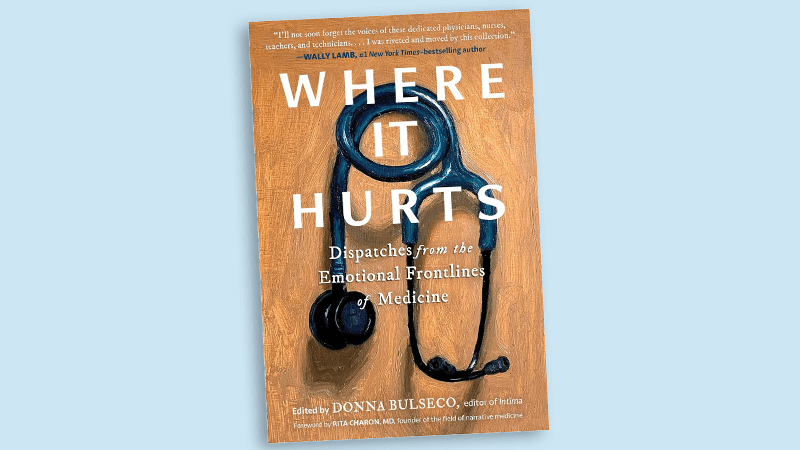
Bulseco, Donna, ed. Where It Hurts: Dispatches from the Emotional Frontlines of Medicine. New York: The Experiment, March 24, 2026.
* * *
She had just lost her husband. Across the room, the practitioner wrote a few words on paper—a brief, ragged bridge between a woman’s fresh widowhood and the electronic intake form’s dropdown menu for mood. The system offered three rigid choices for her soul: anxious, depressed, or other.
None of them were true.
The problem was not simply that the system lacked a sufficient vocabulary; the template had already decided what human experience could be recognized as real. Grief, in this highly choreographed moment, was not to be witnessed but classified—flattened into a selectable field so it could enter the record, move seamlessly through the billing workflow, and become legible to an administrative architecture that cannot afford ambiguity.
This is not a failure of design. It is a design philosophy. And it is a gap I know intimately from the inside.
Working in a traditional Chinese medicine clinic, I sit close enough to the intake process to watch what gets lost in this translation. In TCM, a patient’s symptoms are expressions of an interconnected internal landscape, read through the nuance of a pulse or the specific tenor of a sigh. Yet, when these holistic observations meet the rigid requirements of modern medical documentation, a profound epistemological violence occurs. The distance between what a patient desperately needs to say and what the form accepts is the distance between a life lived and a life ledgered. Across modern medicine, what cannot be easily encoded is slowly rendered unintelligible.
I did not have a precise framework for this quiet erasure until I found Donna Bulseco’s anthology, Where It Hurts: Dispatches from the Emotional Frontlines of Medicine. Drawn from over a decade of work published in Intima: A Journal of Narrative Medicine, the collection gathers more than sixty essays, poems, and short narratives from clinicians navigating this exact tension. With a foreword by Dr. Rita Charon, the founder of narrative medicine, the book does not offer a unified, sterile theory of what is broken in healthcare. Instead, it operates as a shared atmosphere of strain, improvisation, and moral injury—a polyphonic record of what it feels like to care for human beings inside systems never fully designed to hold them.
The anthology’s editor, Donna Bulseco, organizes the collection not by anatomical system or pathology, but by emotional weather—self-doubt, loneliness, fear, and tenderness. Each section has a title that captures this complexity, refusing to let our human feelings be flattened into a single word. This editorial choice is a profound aesthetic statement. It inverts the clinical hierarchy, suggesting that the emotional climate of a hospital room is just as consequential as the disease process itself. By moving through these affective states, the anthology attends to small, painfully concrete moments. We meet a clinician in a psychiatric ward who, rather than attempting to medically correct the vision of a patient who lacks his glasses, removes his own so they can share the terrifying blur. We witness an operating room where a medical student fiercely guards a patient’s chosen name against the voices that keep reverting to the one on the chart.
These are not clinical case studies; they are scenes of radical presence. Modern medicine’s dominant language is efficiency, throughput, and risk management, its architecture designed to move bodies through distinct phases of intervention. Yet the official record has no syntax for a clinician who pauses at the door, or who simply pulls up a chair to bear witness to an unraveling life.
Many of the anthology’s most arresting pieces return to the same pressure point: the chasm between the documented record and the physical reality of the room. In Kaitlyn Reasoner’s “Curveballs,” a COVID‑19 ICU physician describes the profound acts of care that no checklist can hold. When Reasoner tells a young woman her fiancé has died, the woman looks up and says, “We were supposed to get married.” There is no field in the Electronic Health Record for that sentence. There is no dropdown menu for the devastating silence that follows it. What Reasoner carries out of that room is not a data point; it is a weight. The system, by its very nature, demands that this weight be left behind. Where It Hurts is an archive of the weights that clinicians refuse to drop.
The exhaustion of navigating this divide bleeds beyond the hospital doors. In Cara Haberman’s “Being Seen,” clinical machinery collides with an ordinary human moment at a parking gate. After delivering unbearable news, Haberman tries to shrink into anonymity, only to meet the parking attendant’s searching eyes. “A jolt of recognition—it’s her.” The softened gaze and the silent raising of the gate become a merciful counterweight to clinical erasure. By elevating a scene this minor, the anthology makes a political argument: these off‐the‐clock recognitions are the invisible mortar sustaining medical practice, even if they never touch the official record.
What these clinicians share is not simply sentimentality, but a rigorous, cultivated attention. Dr. Rita Charon has spent decades building narrative medicine on a premise that feels increasingly radical in the age of efficiency: that learning to read a person—their metaphors, their silences, their contradictions—is as technically essential as reading an MRI. Read through this lens, Where It Hurts is less a literary collection than a survival manual. These pieces are acts of training, modeling a deep listening that no intake form can teach and no algorithm can replicate.
This defense of human attention matters now more than ever, as “Ambient AI” tools promise to perfect the record with total capture. Microphones record every word at the bedside, instantly translating dialogue into neatly summarized, coded notes. Nothing will be lost, the argument goes. But Where It Hurts serves as a devastating rejoinder. The clinicians in these pages know total capture is not the same as understanding. A machine transcript can log the words, “We were supposed to get married,” but it cannot hold the gravity of the silence that follows. It can record the audio of a paramedic taking off his glasses, but not what that gesture of solidarity meant to a man who could not see. A system can index every syllable and still entirely miss the meaning living in hesitations, trembling hands, and misread names.
This is the ultimate intellectual stake of Bulseco’s anthology. It reminds us that medicine is not merely an information‐gathering enterprise; it is a moral practice. The patient’s experience does not disappear when it doesn’t fit the form; it returns as distrust, chronic pain, or despair. What is at risk in the pursuit of optimized data is not just medical history, but authorship—the fundamental human right to define one’s own reality.
In this sense, “Where does it hurt?” becomes a question of sovereignty. It asks whether the sufferer’s answer will be heard on its own terms, or translated to serve the institution. In a world organized around frictionless optimization, the most consequential decisions are not those producing the fastest outcomes, but those determining what is allowed to count as real.