
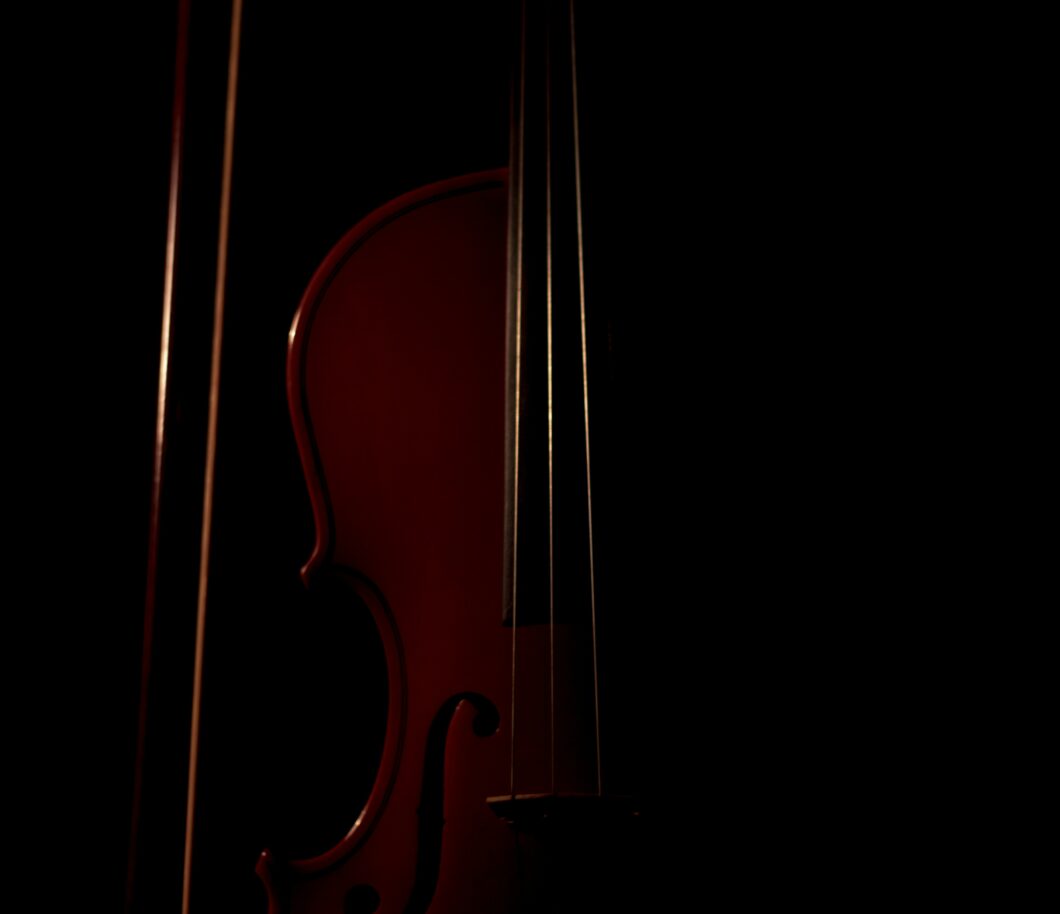
The shop’s sign was violin-shaped, a flat emblem hanging from a thin iron rod. Nicolo watched its shadow stretching and shrinking across the stucco façade. He stood across the square, under a tree that was flashing its underleaves in the wind. A few tall clouds were stacked above the terra cotta roofs: soon a quick storm would wash him clean of the two-days’ walk from Milan. Then he would find a cheap room to stay in, and in the morning he would return to petition the violinmaker.
*
He had left Oggiogno in the fall, after helping bring in the chestnut harvest. On the ferry crossing Lago Maggiore, he watched the roofs of Cannero recede, the largest town he had known becoming a smudge of orange and brown. Above it, dotting the hillside, were the villages of Donego, Oggiogno, Trarego, each a town around a church like a freckle around a hair. Between them, the terraced hills, striped with stone walls that caught the clattering rain of chestnuts as they were beaten from the boughs. The riper fruits were carted away by the women; the firmer ones were raked into mounds to soften in their aggregated warmth; and finally the terraces were left empty, shoals of rotted husks washed up along the endless dry-stack walls that Nicolo knew like the lines of his palms, which looked like that only now, from the boat: faint creases on the sun-browned hill of his childhood.
He walked to Varese and then to Milan. Only three days of walking and the simple bark of the world was pulled back to reveal rot and bloom. He had a letter of introduction from his father to a distant cousin but he did not use it. He was meant to apprentice himself to a furniture maker. He could not do it in Oggiogno, where his brother would replace his father, where one man could meet the wooden needs of the town easily. Only wind-worn shutters and coffins were needed with any regularity. Doors, tables, and chests lasted for generations, and there was no wealth to occasion the finely carved details that Nicolo’s delicate hands alone could bring out. It was fine for a child to carve intricate scenes on the backsides of shutter slats, on the lids of chests, but no one would pay for it. Not his father’s apprentice, then—and relieved of his mother’s plans by her quick and decisive fever and death, three summers ago—Nicolo could strike off for the unknown world.
“But are you sure you want this life, piccola mia?” his father had said. “So lonely, and dangerous? For what, making decorations?” And with that, Nicolo, becoming himself, had set off.
In Milan there was wealth—and decoration—but the putrid munificence occasioned more than surface ornamentation: there were entire industries and economies that had never crossed to the steep north shore of Nicolo’s wide lake. Prostitution was one; another was opera. While his fellows of the cheap rooms explored the former, returning late loud with their tales, Nicolo spent his little money on tickets, full of other passions. The music—and the artifice! That such an assemblage of lies—costumes, plots, fanciful unrealities—could make a true thing: this lodged in Nicolo’s heart like a shard of glass, painful and bright.
On the days he couldn’t afford a ticket, he skulked outside the Teatro Regio Ducale. He learned where the orchestra straggled out at the end of the night. Some were like him, uncouth but for one glimmering skill, friendly in the boisterousness of all drinking that follows working. They talked about the operas, the divas.
And they talked about their instruments. The chalumeaux were made out of boxwood, the violins were maple and spruce—there was even a little instrument made of chestnut wood, the castagnette, two pieces that clicked together sharply, for scenes of Spanish dancing, they said, sultry foreign seductions. Chestnut, castagna: Nicolo felt a flush of provincial pride when the musician showed him a set, the dark grain straight and familiar.
And they spoke of Cremona, where the finest instruments were made. Instruments with souls. Amati, Stradivari, Guarneri: these musical names they spoke in excited and reverent tones. Milan had its artisans too, but Cremona…
So he went there. When his fingers trembled with desire to be making these things, and a second winter sat heavy in the sky over Milan, he resolved: in the spring, he would seek out the greatest of these violinmakers. Until then, he would do any work, and spend no money, except for bread. He left the theatre behind weeks before he left the city, so that he would have something to live on.
*
The morning after he arrived in Cremona, Nicolo returned to the workshop of Giuseppe Guarneri. Under the violin sign, almost white in the morning light, he hesitated, then stepped into a dark entryway. His eyes adjusted to find it empty.
“Delivery?” There was a man in a doorframe to his left, gesturing, and Nicolo saw his father’s hands on this stranger’s arms, and it gave him confidence. A woodworker’s hands, sawdusty and strong.
“No, sir. Is Signor Guarneri here?”
“For what business?”
“I… want to apprentice.”
Another man appeared behind the first, and Nicolo thought it was the master himself. He was younger than Nicolo had expected—still approaching middle age—but he had a stillness of authority.
“Have you any sample of your work?” This was the first man, with a performed tiredness. Dread. Why had it not occurred to him?
The second man came suddenly close and caught Nicolo’s hand. He froze—would he be found out? The moment endured.
“Beautiful fingers,” Signor Guarneri said, running an appraising thumb across the knuckles. There was a covetousness in his look, as if he were considering a tool not yet in his set. “Piero,” he said suddenly.
“Signor?”
“A test block, please, and a bridge.”
“Cello, signor?”
“Violin.”
Something like a smirk crossed the older man’s face. The master dropped Nicolo’s hand and gestured toward the door. “Go on,” he said. “Piero will show you our examination.”
Nicolo stepped into the workshop proper. It was a cathedral compared to his father’s workshop. At least a dozen long tables were ranged across the wide room. Men worked at half of them, but there was evidence of work on every surface. Long hand planes with heaps of pale, curling wood shavings. Rasps, gouges, tools familiar to Nicolo and others he had never seen; still others in familiar shapes but comically small, a row of planes that started at his father’s most delicate and shrank to the size of his smallest finger. Rags, and rafts of paper—orders or correspondence, stencils or guides he did not know—and on the musky ground of wood-spice and faint pungent sweat there were unfamiliar odors, tangy and sweet. Was it wood, or an unfamiliar glue?
Piero gestured for Nicolo to follow him down the aisle between the benches. The light was worse in the back, away from the windows, and he saw why it was used for equipment and overage.
“Have a seat,” Piero pointed to a stool. “Here is a bridge.” He put the object before Nicolo, who recognized it from the instruments of his friends in Milan, a bridge that spanned no river but held the instrument’s strings up, gently arced and finely footed. Removed from the instrument, it seemed delicate and ornamental, but it bore the tension of the strings directly, powerfully strong despite its curved emptinesses.
“Here is a block.” Piero put a small square of wood next to the bridge. The assignment was obvious, but he explained. “Carve the block to match the bridge.” He pointed at a rack of tools nearby. “You may use these.”
The man turned and left him. Nicolo felt a flush of confidence, and then, picking up the block of wood, a twist of dread.
*
When he had finished, Nicolo turned to face the room, observing the tools, the woods, the patience of the makers. Eventually Piero saw him, and then Signor Guarneri came to assess his work. Nicolo handed him the bridge he had carved.
The master looked at him sharply. Of course he knew immediately. Nicolo had a moment of fear. Should he have followed the rules?
But no, he was sure. He held the gaze, and when it turned into a question, he answered it. “The wood did not want to be this shape. I could not abuse it.”
He held up now the original piece of wood, to which he had returned after the bridge, made from a floor scrap of maple, was complete. Its fine, strange grain would have broken under curves; instead, with the smallest plane, he had shaved the middle of the block as thin as he could, until it looked like a framed piece of wood, the center translucently thin.
Signor Guarneri took it from him, and Nicolo knew from the softness in the man’s fingers that he had not misjudged. Craft above vanity, above petty tests: this man was an artist, and he knew what he was looking at. He was distracted from his role of master by the object, which he held up toward the light.
“Remarkable,” he said to himself. Then he asked Nicolo about his training, his experience, and the boy answered honestly and briefly.
“I cannot take an apprentice now,” Signor Guarneri said finally, and Nicolo felt a panicked disappointment, but he went on, “I have commissions, I have deadlines. In the fall, you can apprentice. Until then, only small work. Make bridges, do the little tasks, Piero will show you. I will pay you well.”
Nicolo agreed without asking what well meant. Piero showed him the sweeping, water-changing, scrap-gathering, which tools he could borrow or share to carve bridges after these tasks were complete. He left in the early evening, when Piero left, and made his way meanderingly, with several false starts, to the house, to the hot room under the eaves, where he fell into a dazed and fitful rest of tremulous exhaustion. An apprentice in the fall.
*
Nicolo had been at the shop for four weeks when Signora Martina came. He had earned the grudging friendship of the older craftsmen with his willingness to wipe their benches clean of maple curls twice a day: first while they took long lunches at the café across the square, and again in the cool solitude of the evening. They began to call him Pontino, with a laughing affection. Pontino, Pontinello, little bridge boy.
He had overheard the name Martina several times before he sat by Piero and heard it straight: Martina della Pietà, she was called, from the Ospedale in Venice, she too had studied with Vivaldi there, she was becoming better known even than Anna Maria; she had been performing in Milan. The empress Elisabeth had heard her, had invited the virtuosa to follow when her retinue returned to Vienna. So Signora Martina desired a new instrument.
They did not expect her to arrive at the shop. Signor Guarneri had a letter that she would come to Cremona in the following week, and he had begun arrangements for the hall in the Palazzo Trecchi, where his instruments would be arrayed on elegant tables in graceful acoustics. But a women appeared in the entry of the shop, alone, and it was her.
A woman in the shop! The men did not know whether to assemble respectfully or ignore her respectfully, so they stayed at their benches in an awkward obeisance, holding the tools they held. Nicolo was sitting with oiled rags at the back table, inspecting blades for signs of rust.
A bench was cleared, a cloth put down, the instrument delivered. From the back of the room, Nicolo could not see it between their bodies. Signor Guarneri and the woman were discussing something, and then the master retreated, and in the clear space at the front of the room, backlit by the entryway, there was the woman holding the instrument.
She plucked the strings, adjusted the pegs, and then folded the instrument up to her shoulder. Tuning, she played two strings against each other, and Nicolo felt the moment when they slid into right relation, each to the next, like the doorways at each end of a hallway aligning.
And then she began to play, and through that doorway of sound came her voice—the voice of the violin, the voice of the otherworldly machine that was the woman and her instrument—because it was hers: maybe she had come to see about choosing it, but it had chosen her. And Nicolo realized only now that there had been no music in the shop but the rough wooden songs of tools and hands, that for the months of construction the instruments were silent: even when they had taken form, pale and raw, even when they flushed with varnish, sticky and fragrant in the shaded warmth of the cortile, they were voiceless. Pure potential.
It was with an almost panicked joy that the instrument sang now, a liquid effusion of running scales like clear streams tumbling over smooth stones, and the low strings rich and sweet like honey on plums, dark and fragrant. Nicolo didn’t know the music she was playing—he heard its repeated, ascending figures coiling up into the highest register of the instrument, its local symmetries and occasional spikiness, a darting chatter of song that seemed never to pause on a cadence but to tumble onward. Like a bird, it seemed to him, a bright and frantic joy flashing, darting through the undergrowth of low notes, a thing that could have flashed with quick wingbeats back to the shoulder of God. Except she had trapped it here among them, the melody ascending and tumbling back, caught, flashing iridescent in the air, the bird of song—
—until it ended, or broke off. In the sudden silence, the last notes seemed still to ring.
Nicolo returned to himself, watching the woman who had conjured the bird. Slowly she too returned to herself, lowered the instrument, and opened her eyes. For a velvety moment she did not speak. Then, turning, she smiled at the master. “Bravo, Signor Guarneri. Bravissimo.” The men applauded gently, and she turned to acknowledge them.
And then she looked straight at Nicolo. The shadow of the bird flickered across her face. She seemed to smile at him. She knows, he thought, an impossible thought.
Signor Guarneri had bowed to her. “You bless the instrument with your skill, Signora. Shall we? Piero,” he indicated with a gesture for Piero to take the instrument back, and led Signora Martina toward his office. When they had passed through the doorway into the front room, the men relaxed in a rustle of breath and movement. They turned toward each other and discussed in low voices.
“He will surpass his father, his uncle even.” “They say she will pay two thousand soldi for this instrument.” “An orphan? But who is actually paying?” “She will play it for the emperor! She will carry the name Guarneri to faraway lands—”
Nicolo wrung his rag and picked up a blade. His chest was hot: running eighth notes fluttered under his breastbone. He pressed the blade against his thumb, sensation venting the agitation. To make something sing—to make something that she could make sing—to make something that she held like that, that her strong and sure arms and fingers so precisely could deploy—
The blade bit his finger. A drop of blood bloomed. He licked it off, a spot of salt on his tongue. This body that bled—Nicolo felt the stale and mortal and unbeautiful weight of it. But it could make something of another medium. He saw it daily appearing around him, from the stained fingers of sweat-scented men, unremarkable-looking men, these fine wooden bodies took shape, voices like beautiful women coiled inside them and trembling to be set loose. Set free. In the opera houses and the salons of palazze, and by rougher hands in the town squares and on the wagon of the traveling commedia troupe, which might even reach the hills above Cannero, if the fine weather held… All this music came directly or indirectly from the body. What did it matter, though the body might be—
Nicolo broke off thinking.
Signora Martina did not return to the workroom.
*
The rest of the day passed, and the next. Nicolo heard that the instrument had been delivered to her, and paid for. He tried to remember the mission he had felt yesterday, when the quotidian curls of maple scraps threatened to bury it.
Then, after lunch, Piero summoned him. The signora had requested a second bridge to go with the instrument. She was returning to Milan the next morning: could it be delivered to her room? Send Pontinello with the bridge, the master had said to Piero, laughing at his joke.
Down a hallway of remembered sound, an impossible door opening.
So Nicolo set off across the slumbering afternoon of Cremona, along the edges of streets, skirting the full sun. Signora Martina had stayed with the nuns at San Luca, Piero said. Only a few minutes and Nicolo came to the edge of the yard of the church, the broad-façaded church, silvery blue leaves of olive trees grown up against its hot stone sides. He did not know where to go—surely not the large doors—he went left, slowly along a path that would circle the buildings.
“Giovane,” her voice rang out softly. Nicolo looked up. There she was, a slender hand pulling back a canvas drape that shaded the window. She seemed unduly pleased, looking down at him. “You have a bridge for me?”
“Si, Signora,” Nicolo said, glancing around. He felt like a lover, looking up at her like that, a mad, hot feeling.
“Well, come up, then,” she said, almost mischievously, and pointing with the same hand. “Around the corner.” She was gone, and he circled where she had pointed to find a staircase wrapped against the outside of the structure. The direct access surprised him—shouldn’t some nun be on guard?—and she appeared in the doorway with that same playful look.
“They gave me the priest’s room,” she said, answering his unvoiced question. “A man must come and supervise occasionally,” she said, “of course.” What did that mean? She was retreating into the shadowy room. “Come in,” her voice trailed.
Nicolo stepped slowly into the darkness, which adjusted into a simple, spacious room. A table with two chairs, a low bed, a chest, and the one window he had seen, whose canvas glowed yellow with the diffuse light it was blocking.
“I was hoping they would send you,” she said, standing in the middle of it, looking at him.
“You were?”
“Will you dine with me?”
“I… have the bridge.”
She smiled. “Put it there, then,” she pointed at the table, “and sit.”
He did what she said. She gathered a few things from a board under the window, looking back at him at the table, still with that look, as if she knew.
“What’s your name?”
“Nicolo.” It was, almost.
“Nicolo… where do you come from?”
“North,” he said. “Oggiogno, above Lago Maggiore.”
“Ah, I have heard of the beauty of the lakes. I have never seen them.” She began to prepare things, with a pleasant, confident slowness. In the shaded light, she cut plums in her hand, turning them across the blade, slipping the pits out with her thumb. Then a cloth-draped board, half a loaf of bread. A pewter pitcher of water, a bowl of glistening black olives.
Soon they were seated together. She was peeling an orange, and the smell reached him as her lithe fingers flexed into the fruit, the rind falling cleanly away, the flesh divided in half. He took the offered half. The tight binding under his shirt felt flush, as his heart sped and generated heat.
“So you are apprenticed to Signor Guarneri.”
“Not yet,” he said, turning over an orange slice in his hand. He explained.
“He is a true artist,” she said. “The instrument you heard me play at the shop… It sings like nothing else. Its soul is alive to me.” Her fingers trailed on the table, caressing a ghost of the violin. Then to business: she took up the knife and carved a thick slice of bread for him, another for herself.
They ate and talked. There was an afternoon quietness all around them, and time did not seem to pass: Nicolo did not think of time passing in the workshop, of anyone outside of this room expecting him. Time was plump and entire. She knows, he thought, when she would look at him with a tender amusement: she would look back and forth between his eyes, right-left-right, and over his lips, his smooth chin and lips, and back to his eyes. But she sat without saying it.
“Thank you for the meal,” he said, eventually, with some effort at pulling closed the curtain between them. But she didn’t respond, and it fell away again. There was nothing between them. They were sitting on adjacent sides of the small table, a still life between them. A breeze lifted the window-cloth gently, rippling the half-light on the table.
She moved very slowly so as not to spook him. She moved from her fingertips, touching with a question the edge of his face, then tracing the line of his cheekbone, the line of his jaw. He held himself taut: and then, against his every intention, he relaxed the slightest weight of his head into the cup of her hand.
And then they stood and moved together. She slipped her knowing hand up the back of his shirt and found without hesitation the tightly-wound cloth there. She found the end tucked under and loosed it and laughing quietly she murmured his name as she worked it free.
“Nicolo, Nicolo, Nicolo, Nicola—” She pulled at the cloth until it pulled on the body and turned the body away from her, and then toward, and then away, and as she gathered the binding, damp from sweat and cooling in her hands, she named the body she was unbinding, “Nicola, Nicola,” the true name, until it was unbound. She let the wrapping drop and gently traced the sticky, sweaty contours of the breasts, which were prickling with bloodflow, with evaporating sweat, with arousal.
“How did you know?” Nicola asked her, in the silence of the bed, after they had explored to exhaustion the exquisite sameness of their bodies, their appetites and the satisfactions thereof. The light has aged, shifting and reddening through the window-canvas to cast a muted light. As if they were curled in the ribs of a violin, Nicola thought.
“I did it myself,” Martina answered. “When I first went to Milan. I wanted to play in the orchestra.”
Nicola laughed. “But you were known in Venice! How did you do it?”
“Known,” Martina said. “Yes, but an orphan. Known with only so much attention.”
“You weren’t… discovered?”
Martina laughed, an arpeggio. “Awfully dull, though, the opera orchestra. Only the sopranos really get to have fun.” Nicola felt a pang at this dismissal. She knew the world, Martina did, she had done unimaginable things in Milan and Venice and she would go back to the world imminently, she had wings, and Nicola would only watch her flash back out of sight.
“No, what is it?” Martina turned tenderly toward the look of loss that had bloomed on Nicola’s face. As if, her disguise once opened, she had no secrecy, she was all transparency to this woman.
“You’re leaving,” she said, meaning it in its fullness. And Martina heard it.
“Ah—yes. But I will think of you, and when I return to Milan, you will come to hear me play.” She said this as if it would be enough. Nicola imagined capturing a sky-tall sunlit thunderhead, reeling its diffused enormity back into a little corked jar. And waiting.
But since there was nothing else to be done, they did it. The dimmed light of the afternoon shifted and fell off the table, onto the chair, onto the floor, and the violinist tenderly restored her lover to his decency, and they separated themselves at the door.
He returned to the shop, remade, and nobody asked about the hours. They had been working, gluing together the perfectly planed halves of violin backs, angling the seams into the same still and bright afternoon light, checking with meticulous care that not the tiniest shadow of a gap licked along the seam, or else it would not hold.
*
A fly buzzed quietly, embroidering the heavy air of the afternoon. Early spring, hot already. Nicolo carried his pail out carefully, the handle creaking with every step, to splash the tangy, cloudy wastewater into the cobbled sewer that ran out of the square. Across the way, the café was reopening for the evening, tables pulled out into the widening shade of the awning. The clock face said 5:05. Nicolo hadn’t heard it toll. So he was at home here, he thought suddenly. The clamor of public time in this new place was familiar in his head. He crossed to the fountain, rinsing and filling his pail, appraising the shop front that was still struck by full sun. The sign hung still in the ripe afternoon air, an unvarnished violin back carved with an ornate G. Guarneri. Or del Gesu, as they were starting to call him.
A message had come from Vienna yesterday. Signora Martina had played there, and the emperor wrote to order a quartet of instruments. It took a month for letters to cross the mountains. She could be in Paris by now, playing for the young king. She could be in Oslo, warming her fingers in velvet gloves or fur, or on the lips of pale northern beauties. But she would come back. Someday he would make an instrument with the grace of her shoulders and hips, with the golden smoothness of her taut lower back, the dappled brown ribs of her ribs. Its unplayed song would call to her and she would come back and play it to life.
Nicolo returned to work. That was the trick: to feed the enormous vision with the smallest offerings, the hours and minutes of patient, frustrated, patient, frustrated learning. He looked at the bridge on his desk, half-carved and pale. The bridge was not glued to the instrument: it was only held in place by the four strings, tightened into tune again and again as the pegs slipped and the gut stretched and expanded in the heat. If he made ten perfect bridges, then ten more—if he served his apprenticeship faithfully, he would eventually learn how to join the two blocks of maple with a perfect, gapless seam; how to gouge and plane the wide block with a thousand small gestures into the curve—so natural-seeming, like a chest swelled with a full breath of air, but constructed with such meticulous craft and artifice—and to frame the ribs around Signor Guarneri’s perfectly calibrated mold. To build an instrument.
And meanwhile the chestnuts would be ripening on the slopes of Donego, branches creaking under their weight. His father would be planing long slats of chestnut and cedar, fitting snug joints for the winter and slatted shutters for the summer, building two or three coffins a year until one of them was his own. Maybe they would not meet again in this life.
And maybe his skill would not call his great love back: maybe he would make dozens of violins and none of them would tempt a bird from heaven. They would be only good enough for a common man, maybe his finest violin in the hands of a traveler would play a tune in Milan, in Varese, maybe it would be wandered and played some day even up the steep stone paths above Lago Maggiore, and Nicola’s father, building his rectilinear wooden steps slowly into the heavens, would pause and listen.
And breathe.
And resume his work with a new gladness.
Photo by Michelen Studios on Unsplash