
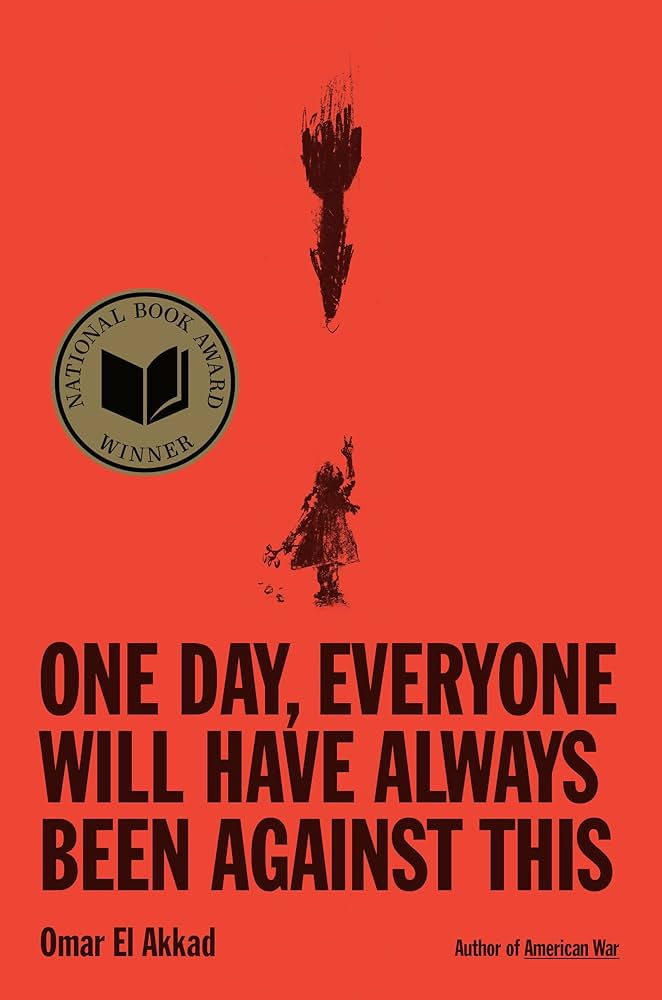
Alfred A. Knopf, 2025 | Winner of the National Book Award for Nonfiction
There’s a joke nestled in the title of Omar El Akkad’s book, One Day, Everyone Will Have Always Been Against This: the inherent contradiction between “one day” and “always.” Not all people are against it now, but one day, they always will have been. The logical incongruity employed here is El Akkad calling out Western liberal hypocrisy, something he does more eloquently and forcefully in this book than any writer in recent memory.
In broad terms, the “this” being referred to in the title can be interpreted as the countless injustices and atrocities leveled against groups of people around the world that the Western liberal order has deemed to ignore, sometimes out of convenience, sometimes because the West is directly profiting off this suffering. Only after it no longer matters in terms of real-world consequences will our leaders make some empty sign of opposition or even acknowledgement that systemic cruelties were inflicted (think: Western governments recognizing Indigenous people’s land long after the group has been displaced from it). The most immediate and devastating example of this dichotomy is the genocide currently being committed against the people of Palestine. El Akkad’s book, more than anything, can be seen as a rallying cry—a term so often used when describing literature of this sort that it has perhaps lost all meaning. Let me see if I can wring out a few more drops from this tired cliche: El Akkad’s book is a cry of anguish, rage, exasperation, and desperation. I can say in no uncertain terms that no book in the past ten years has had such a profound and penetrating effect on me.
One Day, Everyone Will Have Always Been Against This is a potent and affecting blend of personal essay and stark political commentary. Similar to the nonfiction work of Ta-Nehisi Coates, El Akkad places his own story in a larger social context that brings both the personal and the political to sharp relief. El Akkad was born in Egypt, but moved to Canada with his parents as a teenager. His career as a journalist for The Globe and Mail gives him insight into the machine of the American Empire, whether this was going on tour with Canadian forces during the war in Afghanistan, or witnessing first-hand the inner workings of military trials on Guantanamo Bay. In a tone that is a blend of the grim and hardened reporter and the outraged bafflement of the individual, El Akkad details the functions of a machine that only works for a select group of people. This machine is dependent on the narrative that Westerners are always the true heroes in the story; everyone else is, at worst, the villain, and at best, completely disposable.
While on assignment in Afghanistan, El Akkad describes how the soldiers refer to the Afghan dead, “peppered into conversations as a means of conveying the seriousness of the situation without upending the narrative.” He goes on to write that this framework reminds him of modern American war movies, when a morally upright soldier must choose whether to shoot a “small Brown child or a woman in a niqab,” in the event they might be carrying a suicide bomb. “Surely any rational narrative assessment of the situation would conclude that the center of the story is not the sniper,” El Akkad writes, “but the person on the other side of the scope whose life hangs in the balance. But the dead, unnamed, serve their purpose. It is the purpose of Westerns to contend with stakes, it is the purpose of everyone else to establish them.”
What sets this book apart from other criticisms of late-stage Western capitalism and empire is El Akkad’s refusal to let off the hook what many see as bastions of liberal democracy, whether this is the Democratic Party, the news media, or even large pockets of the literary community. El Akkad exposes the fecklessness of a host of literary organizations that, in one way or another, have failed to stand up and speak out against the genocide happening in Gaza, and often censor those who do. Cuttingly, El Akkad likens these literary institutions to “reputation-laundering firms” with a well-read board.
Perhaps the most controversial view in the book is El Akkad’s blunt questioning of the “lesser of two evils” argument offered by liberals defending a binary American political system that makes no space for entire groups of people, and when it comes to a genocide being perpetuated with the backing of American dollars, can only offer up empty lip service (sometimes not even that). El Akkad argues that the modern American liberal has become more concerned with what they appear to oppose or defend than making any actual meaningful progress; everything is then reverse-engineered. Slogans become more important than actions. “When there are no real personal stakes,” he writes, “when the missiles are landing on someone far away, being seen as good is good enough.” El Akkad instead calls for a new path to be forged. He argues that meaningful change can happen only when enough people have exited the system and withheld their participation in favor of something new. What this new system would look like, he doesn’t try to suss out (indeed, that is not his job), but the idea resonates. While I can imagine many liberals balking at this point of view, I can say that this clear-eyed diagnosis of the vapidness of the modern Democratic party offers up the best explanation for the rise of Donald Trump and the far-right that I have seen articulated.
El Akkad’s first book, American War, is a novel that imagines the United States in the grips of a second civil war over fossil fuels. In One Day, Everyone Will Have Always Been Against This, El Akkad begins to question the purpose of art that examines joy and beauty in the face of so much global devastation. “So many of my favorite authors care about the moon,” El Akkad muses. “So much of my favorite literature orients in the direction of beauty . . . [but] no description of the moon, no matter how stunning . . . reflects as much beauty back into the world as a missile obliterating a family in their home takes out of it.” The question of the purpose and function of art during and alongside suffering is massive and complicated, and perhaps does not get enough time or nuance in this book—I would be eager to read more of El Akkad’s thoughts on this idea. But putting the question of art aside, the fact remains that many of us are going out to dinner, attending concerts, playing Wordle on our phones, planning vacations, while thousands are being slaughtered. El Akkad’s book forces you to sit with this disturbing juxtaposition.
Gut-wrenching and agonizing, El Akkad is a deft, skilled writer, and the book is somehow compulsively readable (I finished it in a few sittings). But I imagine there are many readers who might give up on this book halfway through, if not avoid it entirely, because they believe it will make them feel impotent and hopeless. One thing I hear a lot these days (especially from other white people) is the urge to turn off the news and check out because “it’s just too much,” and “they can’t take it anymore.” To me, that feels like the ultimate sign of fragility and abuse of privilege. Ignorance is bliss, to be sure. It may also be humanity’s doom. But El Akkad never succumbs to complete hopelessness; nearing the end of the book, he offers glimmers of hope in the solidarity of individuals and groups who have stood up in one way or another for the people of Palestine, whether it’s protestors on the streets, government officials resigning from their posts in opposition to their country’s policies, or writers and artists turning down compromised prize money. El Akkad quotes the Palestinian poet Rasha Abdulhadi: “Wherever you are, whatever sand you can throw in the gears of the genocide, do it now… Get in the way however you can.”
Yes, while reading this book, I felt anguish for those suffering, and rage at my own powerlessness. But perhaps most of all, I felt guilt at not doing more to help in the tiny ways that I can. I do not think this is a bad thing, though. Too often, we turn away from anything that makes us feel uncomfortable or in the slightest way convicted. But there are times when guilt can be a healthy and appropriate response to a situation, especially if it leads to something productive. I believe now is one of those times.
Near the end of the book, El Akkad writes about resistance and how it can be active or negative. Protesting on the streets and speaking out in the ways that you can are examples of “active resistance.” Withholding your participation from complicit organizations or institutions is “negative resistance.” El Akkad argues that both forms of resistance are necessary and productive. I found this dichotomy helpful and encouraging. At times like these, when things feel at their darkest, it is important not to grow paralyzed by guilt, fear, or hopelessness. We must create both active and negative resistance by closely examining what and who gets our time, money, and participation. We must help in the tiny ways that we can, throwing as much sand “in the gears of genocide” as possible.